Your Memory,
Your Authorization.
UOMP lets users grant AI Agents temporary, scoped access to personal memory data — memory stays local, permissions are always revocable.
One SDK,
Two Deployment Modes.
UOMP offers CLI and browser entry points, both backed by the same SDK and protocol. Pick what fits you.
Connect your wallet + Dropbox. Manage your portfolio encrypted in browser. No server, no CLI.
Try in Browser →Use @uomp/sdk and CLI tools. Agents access data with Capability Tokens from any environment.
Data stays local,
authorization stays with you.
Today's AI Agents need access to vast amounts of personal data to provide personalized service. Existing solutions usually require users to upload data to third-party servers, which means users lose direct control, Agents may retain data indefinitely, and access is hard to audit.
UOMP changes this: your memory stays on your device, and Agents only receive temporary, minimal, auditable access.
Four principles,
one goal.
User Sovereignty
You always own and control your memory data. It never moves to an Agent provider.
Least Privilege
Authorize by tag or exact key. Unauthorized data is inaccessible by default.
Session Isolation
Each grant is bound to an independent session. Access ends when the session ends.
Auditable
Every access is logged so you can see exactly what each Agent read or wrote.
Five steps,
one authorization.
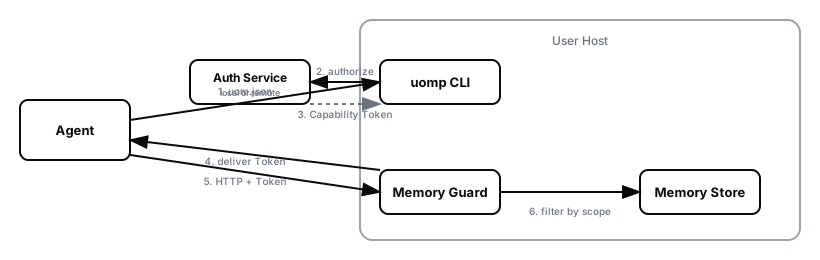
- Discover an Agent: Browse an Agent marketplace (e.g., an ERC8004-based registry) or a local directory.
- Review the Manifest: The Agent declares its identity, requested memory scope, and field-level purpose in
uom.json. - Connect & Authorize: You verify the Agent with
uomp connect, then confirm the scope withuomp authorizeto obtain aUOM_TOKEN. - Run the Agent Independently: You provide the Token to the Agent process, which reads data through Memory Guard within the authorized scope.
- Disconnect: The session expires or you revoke it with
uomp revoke, and the token becomes invalid immediately.
Built for three groups,
for one open standard.
Users
Regain control over personal data and know exactly which Agents accessed what.
Agent Developers
Access user-authorized data through a standard protocol without building your own store.
Protocol Researchers
Help design an open, decentralized authorization standard for Agent memory.
Explore UOMP
Read the protocol draft, check out the reference implementation, or join the GitHub discussion to build a user-sovereign Agent memory authorization standard together.